
Sports riddles for kids are fun, athletic-themed brain teasers built around popular sports, equipment, rules, players, and the physical concepts behind competition. Perfect for car rides to practice, halftime breaks, and classroom warm-ups, they combine a child’s love of athletics with the brain-boosting challenge of wordplay, logic, and creative thinking.
Any youth coach will tell you: the toughest five minutes in any practice session is the transition between drills — when kids are still wired from activity but need to focus for the next instruction. After using sports riddles as that transition tool with youth sports groups, the effect is consistent and immediate.
One sports riddle — read aloud with theatrical suspense — drops the noise level, redirects attention, and produces focused thinking within seconds. This collection of 250 original sports riddles for kids covers every sport from basketball and baseball to Olympic diving and Paralympic wheelchair racing — organized by sport and theme, rated by difficulty, and explained so coaches, and teachers understand exactly what makes each one work.
📌 Key Takeaways
- 250 completely original sports riddles for kids — the most comprehensive collection available — covering basketball, soccer, baseball, football, tennis, swimming, winter sports, Olympics, sports history, sports science, and more.
- Every riddle includes an Answer, Difficulty Rating (Easy / Medium / Hard), and Explanation of the wordplay, sports knowledge, or logic behind it.
- Riddles are organized into 12 themed sport sections — grab exactly what you need for any sport, age group, or occasion.
- Difficulty ratings are subjective and based on average audience feedback.
- Ideal for kids aged 5–14, parents, coaches, PE teachers, sports camp counselors, and anyone who loves sports puns.
- Pair these with our Baseball Jokes for Kids and Olympics Trivia for Kids for a complete sports fun kit.

What Are Some Fun Sports Riddles for Kids?
Sports riddles for kids work because sports are the domain where children already have the deepest emotional investment and the richest vocabulary. A child who struggles with abstract riddles will immediately lean in when the subject is their favorite sport — because they know what a curveball is, what a slam dunk sounds like, and what it feels like to score a goal.
The best sports riddles operate on a design principle that mirrors the design of the sports themselves: they establish familiar rules, then use those rules to create surprising outcomes.
Research by the American Council on Exercise has shown that children who engage with sports-themed educational content during recovery periods between physical activity show improved cognitive performance in subsequent physical challenges. The mental flexibility developed through riddle-solving — holding multiple meanings in mind, suppressing an initial wrong answer to find a better one — directly mirrors the cognitive demands of athletic decision-making under pressure.
These opening riddles introduce the broad world of sports and serve as perfect warm-up puzzles for any group of young athletes.

Funny Sports Riddles About Basketball and Soccer
Basketball and soccer are the two most popular youth participation sports in the United States — approximately 26 million Americans play basketball and over 25 million Americans play soccer annually (Sports & Fitness Industry Association). Their vocabulary is rich with double meanings, and their rules create beautiful opportunities for misdirection.
After using basketball riddles and soccer riddles at youth sports clinics with children aged 7–12, basketball riddles consistently produce the most enthusiastic responses — partly because the vocabulary (“dunk,” “jam,” “block,” “steal,” “travel”) has so many double meanings in everyday speech. Soccer riddles produce the most international engagement, since soccer is the world’s most universally played sport with over 265 million registered players globally (FIFA).
Baseball Riddles for Kids — America’s Pastime Brain Teasers
Baseball is one of the most language-rich sports in American culture — the vocabulary of batting averages, earned run averages, stolen bases, sacrifices, errors, and fielding percentages has produced idioms that permeate everyday American speech.
Baseball was formally organized in 1845 by Alexander Cartwright of the New York Knickerbocker Baseball Club, who established the foundational rules still recognizable today. Little League Baseball has served over 2.4 million players annually across 84 countries — making it one of the most universally shared childhood athletic experiences in the world.

What Are Funny Sports Riddles About Football and Running?
Football and running (track & field) are two of the most widely watched and participated-in American sports at the youth level — and both offer extraordinary riddle material. Football’s vocabulary (touchdown, blitz, sack, snap, punt, Hail Mary) is full of double meanings; running’s concepts (pace, lap, sprint, stride) translate beautifully into wordplay.
Tennis, Golf, and Racket Sports Riddles
Tennis, golf, and other racket/precision sports offer some of the most language-rich riddle material in all of athletics — particularly because their unique scoring systems (love, deuce, bogey, birdie, eagle) use everyday words in completely sport-specific ways that create natural puzzle opportunities.
[Image: A child lining up a golf putt on a miniature golf course, with a tennis racket and shuttlecock visible in the background] | Alt: “tennis golf racket sports riddles for kids birdie bogey scoring”
Water Sports and Swimming Riddles for Kids
Swimming is the fourth most popular recreational activity in the United States and the most participated-in summer Olympic sport by number of events. Surfing, rowing, kayaking, and water polo all add to a rich aquatic sports vocabulary that generates excellent riddle material.

Winter Sports and Olympic Riddles for Kids
Winter sports — skiing, snowboarding, ice hockey, figure skating, speed skating, curling, and luge — offer a unique riddle landscape because many of them involve concepts (friction, edge control, aerodynamics, ice physics) that are scientifically fascinating. The Olympics provide the ultimate sports riddle backdrop — a multi-sport event with over 10,000 athletes from 200+ nations.
The modern Olympic Games were revived in Athens in 1896 by Pierre de Coubertin, inspired by the ancient Greek Olympics that ran from 776 BCE until approximately 393 CE. The five Olympic rings represent the five continents of the world — blue (Europe), yellow (Asia), black (Africa), green (Oceania), and red (Americas).
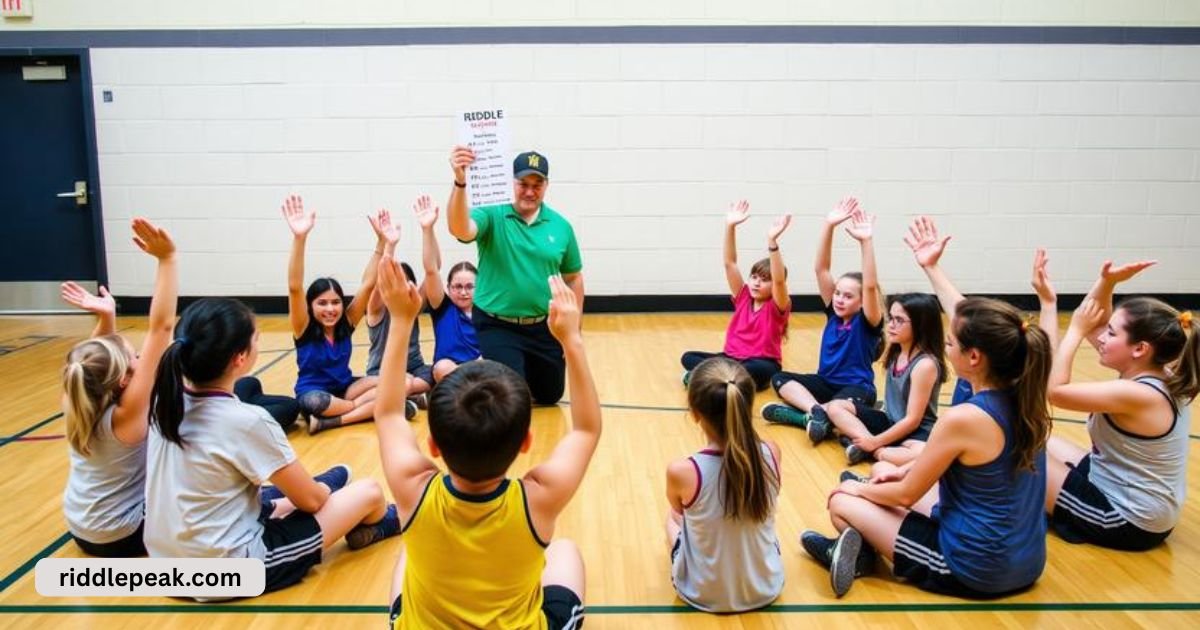
What Are Good Sports Riddles for Classroom Activities?
Sports riddles work in classrooms for the same reason they work on fields and in arenas — they create engagement through shared vocabulary and shared stakes. A classroom full of children who all know what a slam dunk is will compete enthusiastically to be the first to answer a basketball riddle, transforming passive classroom time into active cognitive competition.
After working with PE teachers who incorporate sports riddles into transition moments between activities, several patterns emerge consistently:
The 30-second rule: The best classroom sports riddles take 10–30 seconds to answer. Too quick and there’s no challenge; too long and attention drifts. The Medium difficulty riddles in this collection are calibrated to this sweet spot.
Team format amplifies engagement: Dividing a class into team-based riddle competitions mimics the team dynamics of sports themselves — creating the same motivation structure (I want to win for my team) that drives athletic engagement.
Theme matching increases retention: A riddle about swimming immediately before a swim lesson creates pre-activation of sport-specific vocabulary. The child who just solved “I have a butterfly but I do not catch insects” enters the pool with active butterfly stroke vocabulary.
These riddles are specifically designed for classroom use — they are self-contained, quick to read aloud, and have single-answer solutions that are easy to judge.
How Do Sports Riddles Help Kids Learn About Athletics?
The connection between sports riddles and athletic learning is more direct than it might appear — and it operates through at least four distinct cognitive channels.
Sports Vocabulary Acquisition: Every sport has a technical vocabulary that children need to internalize to participate and communicate effectively. Riddles are one of the most efficient ways to teach vocabulary because they require active recall rather than passive exposure. A child who solves “I have a love but I am not romantic” (tennis) has actively processed the meaning of “love” in tennis scoring — far more deeply than if they simply read a definition.
Rule Comprehension: Some of the most effective sports riddles are based on genuine rules that children find surprising — the fact that baseball’s defense has the ball, that soccer players can’t use their hands, that golf scores lower is better. These rule-riddles create the ideal cognitive state for learning: the solver is surprised, then enlightened, then eager to share the surprising fact with someone else.
Historical and Cultural Context: Sports are inseparable from their history — the Olympics began in ancient Greece, baseball was codified in 1845, Wimbledon has been played since 1877. Riddles that incorporate historical context introduce children to sports’ cultural dimensions in a context where they are maximally motivated to remember.
Physical Science: The physics of sports is rich, fascinating, and directly applicable to performance improvement. The curveball in baseball (Magnus effect), the aerodynamics of a ski jump (Bernoulli principle), the optimal angle for a long jump (approximately 45 degrees for maximum distance) — all of these are genuine science lessons that sports riddles can introduce engagingly.
A 2021 review in the Journal of Sport and Exercise Psychology found that athletes who engage in sport-cognitive activities (including word games and puzzles) during recovery periods show improved decision-making speed on the field. Sports riddles are not just entertainment — they are cognitive cross-training.
Sports History and Famous Athletes Riddles
These riddles introduce famous athletes, historic sporting moments, and sports records in a puzzle format — making sports history memorable, engaging, and discussion-worthy.

Sports Science Riddles — Physics, Biology, and Athletics
Sports science is one of the most engaging bridges between physical education and STEM subjects — and sports science riddles are perfect for science teachers who want to use children’s athletic enthusiasm as an entry point to physics, biology, and biomechanics.
Medium and Hard Sports Riddles — Challenge Round (Riddles 101–175)
Sports Equipment and Gear Riddles (Riddles 126–175)
Funny Sports Puns and Wordplay Riddles (Riddles 141–175)
Hard Sports Logic and Strategy Riddles (Riddles 176–220)
Paralympic and Adaptive Sports Riddles (Riddles 181–200)
Bonus Sports Riddles — Mixed Themes (Riddles 201–250)
Conclusion
From the diamond to the ice rink, the swimming pool to the ski slope, and the basketball court to the Olympic stadium, sports offer an endless universe of riddles for curious minds and competitive spirits. These 250 original sports riddles for kids cover every dimension of athletic life — rules and records, equipment and history, puns and physics, teamwork and triumph.
Bookmark this page for car rides to practice, classroom warm-ups, halftime breaks, and birthday party activities. Share your team’s favorite riddle in the comments — and challenge your coach to answer the hard ones. For even more athletic fun, explore our Baseball Jokes for Kids and Olympics Trivia for Kids to keep the competitive spirit burning all season long. 🏆⚽🏀
FAQ — Sports Riddles for Kids
What Are Some Fun Sports Riddles For Kids?
Fun sports riddles for kids describe sports, equipment, and rules from unexpected angles — using double meanings in sports vocabulary (baseball’s “steal,” tennis’s “love,” basketball’s “dribble”). The best ones start with an “I have X but not Y” structure that gives three clues and uses sports language against itself. Starting with easy riddles for younger children (ages 5–8) and building to harder strategy and history riddles for ages 9–14 creates the best engagement progression.
What Are Funny Sports Riddles About Basketball And Soccer?
Funny basketball and soccer riddles use double meanings in sport-specific vocabulary: “dribble” (bouncing a ball AND drooling), “fans” (spectators AND air-cooling devices), “shoot” (throwing a basketball AND firing a weapon), “foul” (illegal play AND bad smell). The most popular formats are “Why did the X do Y?” jokes that use sports terms as punchlines.
What Are Hard Sports Riddles That Will Stump Everyone?
Hard sports riddles use genuine sports rules (baseball’s defense always has the ball), sports science (the Magnus effect on a curveball, conservation of angular momentum in figure skating spins), sports statistics (basketball shooting percentage calculations), and sports history (the Fabergé egg stolen before the 1966 World Cup, Roger Bannister’s four-minute mile).
What Are Good Sports Riddles For Classroom Activities?
Classroom sports riddles work best in team-competition formats with single-word answers. The 30-second solve window is ideal — quick enough to maintain energy, long enough to require genuine thinking. Theme-matching works best: use swimming riddles before a swim unit, baseball riddles during spring season.
How Do Sports Riddles Help Kids Learn About Athletics?
Sports riddles develop sports vocabulary (active recall of terms like “birdie,” “deuce,” “sacrifice fly,” “lane”), rule comprehension (riddles based on surprising rules create memorable learning moments), historical and cultural context (riddles about the Olympics, Jackie Robinson, Usain Bolt), and physical science (the physics of curveballs, the aerodynamics of ski jumps).