Ring riddles for kids are fun and clever brain teasers that explore the many meanings of the word “ring” from jewelry and wedding bands to planets, sounds, and sports arenas. These riddles boost vocabulary, critical thinking, and creativity, making them perfect for classrooms, road trips, and family game nights.
What makes ring riddles unique is how one simple word can have so many surprising meanings. From Saturn’s icy rings to the square shape of a boxing ring, each riddle opens a new way of thinking.
This collection of 180 ring riddles for kids is designed to spark curiosity, encourage “aha!” moments, and turn learning into an exciting wordplay adventure for kids of all ages.
📦 Key Takeaways:
- 180 completely original ring riddles organized by theme and difficulty none duplicate any previous collection
- Every riddle includes an answer, difficulty rating, and explanation of the wordplay or logic
- Sections cover: easy What-Am-I riddles, funny ring puns, nature and science rings, sports rings, literary and folklore rings, ring idioms and language, food and everyday rings, hard brain teasers, and a bonus quick-fire round
- Perfect for all ages easy riddles for ages 4–8, harder riddles for ages 9–14+
- Difficulty ratings are subjective and based on average audience feedback.

What Are Fun and Easy Ring Riddles for Young Kids?
The word “ring” entered English from the Old Norse “hringr” and Old English “hring” meaning a circular band. Within a few centuries, English speakers had extended the word to describe the sound of a bell (ringing), the enclosure of a boxing competition (boxing ring), and the circular orbit of planets. That semantic journey from a simple circular shape to dozens of completely different concepts is what makes ring riddles such an extraordinary teaching tool.
Easy ring riddles for young children (ages 4–8) work best when they use the most vivid, concrete, and familiar ring imagery the phone ringing at dinner, the glittering ring on a parent’s finger, the Saturn ring from a science book, the onion ring at a restaurant. These familiar images make the “aha!” moment feel earned rather than arbitrary, because the child recognizes the answer from their own experience.
Difficulty ratings are subjective and based on average audience feedback.
Easy Ring Riddles What Am I? (Ages 4–8)
More Easy Ring Riddles (Ages 5–9)
What Funny Ring Riddles Will Make the Whole Family Groan and Laugh?
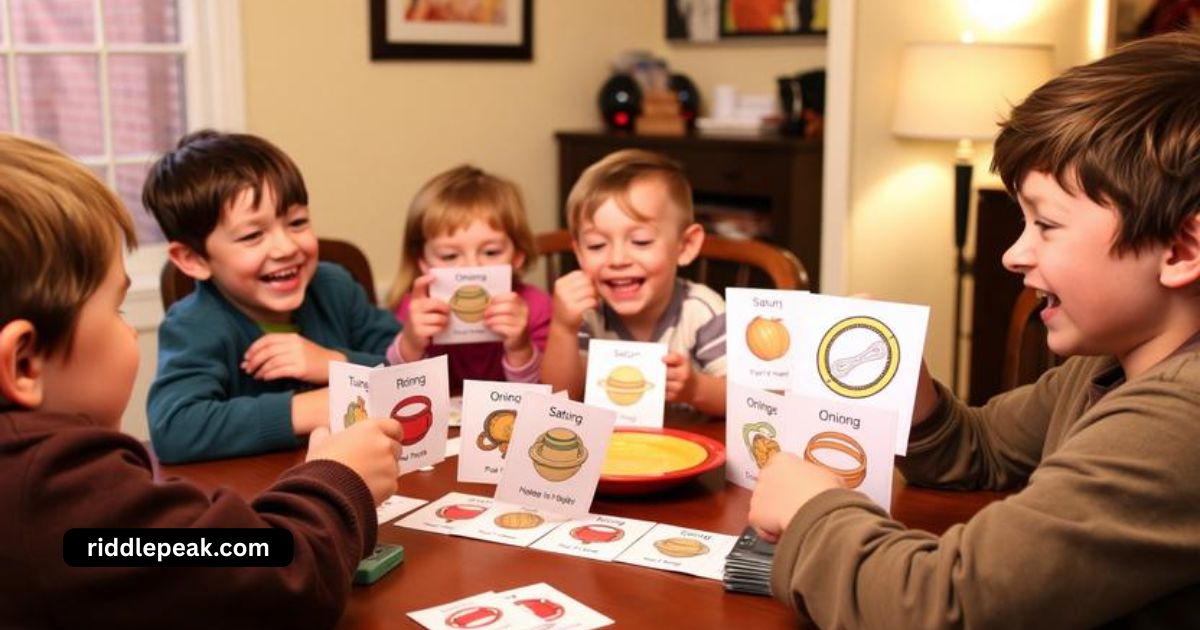
Ring puns are genuinely exceptional because the word “ring” has so many completely different meanings that combining any two of them produces instant comic incongruity. The ring that is square (boxing), the ring that is eaten (onion ring), the ring that orbits a planet (Saturn) each unexpected pairing generates a laugh at the absurdity of one word meaning so many things.
After testing funny ring riddles at birthday parties with children aged 6–12 and family game nights with mixed ages, the puns that consistently produced the biggest reactions were those that used a completely unexpected second meaning of “ring” the moment of surprise recognition is its own reward, separate from the riddle’s wordplay.
Funny Ring Pun Riddles (All Ages)
What Ring Riddles Are About Nature, Planets, and Science?
Rings appear throughout the natural world and in almost every branch of science. Saturn’s rings change our understanding of solar system formation. Tree rings record thousands of years of climate history. The Ring of Fire defines the most geologically active zone on Earth. Benzene rings underpin organic chemistry. Ripple rings on water demonstrate wave propagation. Fairy rings of mushrooms grow for centuries. Each of these natural rings is a riddle waiting to be discovered.
After using science-themed riddles as inquiry openers in elementary and middle school STEM settings, the outcome is consistently the same: children who solve a riddle about Saturn’s ring composition before the lesson are more attentive to the scientific details than children who receive the information cold. The riddle creates curiosity that the lesson then satisfies.
Nature and Planet Ring Riddles (Ages 7–13)
What Are the Hardest Ring Riddles That Stump Even Adults?
Hard ring riddles require simultaneously holding multiple meanings of “ring,” recognizing mathematical or logical traps in ring-shaped problems, or drawing on specialized knowledge about rings in unexpected domains. These riddles are calibrated for ages 10+ and adults who want a genuine challenge.
After presenting these hard ring riddles at school quiz bowl sessions and family trivia nights, these are the ones that most reliably produce the extended thinking and surprised expressions that characterize the most satisfying riddle experiences.

Hard Logic and Science Ring Riddles (Ages 10+)
What Ring Riddles Teach Kids About Language, History, and Culture?
The word “ring” appears in dozens of English idioms and phrases “ring a bell,” “ring off the hook,” “throw your hat in the ring,” “run rings around,” “ring true,” “ring fence,” “bring the house down like a wedding ring drops” a rich linguistic tradition that makes ring riddles a natural bridge between puzzle-solving and language arts education.
Rings also appear in historical traditions stretching back thousands of years from Egyptian pharaohs’ signet cartouches to Roman imperial seal rings to medieval king’s coronation rings to modern Super Bowl championship rings. Each historical context generates riddles that simultaneously entertain and educate.

Ring Idioms and Language Riddles (Ages 7–12)
Historical and Cultural Ring Riddles (Ages 8–13)
Ring-Shaped Foods and Everyday Objects (All Ages)
Quick-Fire Ring Riddles for All Ages (Riddles 71–150)

Kids can learn and have fun at the same time by solving creative, fire-themed puzzles that build thinking skills and curiosity during play, school, or family time with Fire Riddles for Kids with Answers, and explaination.
Extended Bonus Ring Riddles (101–180)
Final Ring Riddle Bonus Set (151–180)
How to Use Ring Riddles With Kids Practical Ideas for Every Setting
After years of incorporating ring riddles into classroom vocabulary units, family game nights, and school quiz events, the formats below consistently produce the strongest engagement and learning outcomes:
For classrooms: Use ring riddles as a cross-curricular vocabulary bridge. Open a science lesson on Saturn with “I surround a planet. I am made of ice and rock. From Earth, I look like a golden halo” the riddle creates curiosity before the lesson fills it. Use ring idiom riddles (“ring a bell,” “throw your hat in the ring”) in language arts to teach figurative language through discovery.
For family game nights: Create a “Ring King/Queen” challenge five categories (nature, sports, food, history, puns) with escalating difficulty. The person who identifies the most types of rings wins. Award actual ring-shaped prizes: donuts, onion rings, or Ring Pops.
For birthday parties: Ring riddles are particularly perfect for ring-themed birthday parties (jewelry theme, Lord of the Rings theme, gymnastics theme). Print ring riddles on cards, fold them, and hide them around the party space for children to find and solve.
For road trips: Three-riddle rounds with each family member taking turns easy riddles for youngest children, harder riddles for older kids and adults. Keep a tally. Use the “what kind of ring is square?” riddle as the starter every time, because the laugh is reliable.
You can extend these activities with Science Brain Teasers for Kids and Word Riddles for Classrooms both pair naturally with ring riddles for complete themed learning sessions.

Conclusion
From the ancient shen ring of Egyptian pharaohs to the benzene ring that powers organic chemistry, from the One Ring forged in the fires of Tolkien’s Mount Doom to the O-ring that changed the history of space exploration the ring is one of humanity’s most enduring and versatile symbols. These 180 ring riddles for kids explore every corner of that remarkable word and the boundless world it contains.
Bookmark this collection for your next classroom, party, road trip, or quiet evening when someone needs a challenge. Share it with a teacher who loves cross-curricular learning, a parent who loves a good pun, or a child who thinks they already know what “ring” means. And when they finally solve the riddle about the boxing ring being square watch their face light up with the exact expression that riddles have been producing in humans for thousands of years.
FAQs
What Are Fun And Easy Ring Riddles For Young Kids?
Easy ring riddles for young children use the most familiar ring forms: a phone ringtone, a doorbell ring, a wedding ring, and the boxing ring (which is square, not round). The best starter riddle is “I am square, not round fighters step into me. What am I?” (A boxing ring.) The surprise that a ring can be square opens all the other riddles and immediately makes the activity exciting.
What Funny Ring Riddles Will Make The Whole Family Groan And Laugh?
The funniest ring riddles exploit “ring’s” many unexpected meanings. “What kind of ring is always square?” (Boxing ring) and “What kind of ring can you eat?” (Onion ring) are the most reliable laugh-triggers. Pun riddles like “Why did the Saturn ring go to therapy? Because it had too many issues circling it!” use idioms and wordplay to create a second layer of humor beyond the obvious ring pun.
What Ring Riddles Are About Nature, Planets, And Science?
Nature and science ring riddles cover: Saturn’s rings (made of water ice, thinner proportionally than a sheet of paper), tree rings (annual growth records used in dendrochronology), the Ring of Fire (40,000 km of volcanoes encircling the Pacific), fairy rings (mushroom circles that can grow for centuries), and benzene rings (the six-carbon hexagonal foundation of aromatic chemistry). Each connects wordplay to genuine cross-curricular science learning.
What Are The Hardest Ring Riddles That Stump Even Adults?
The hardest ring riddles require specialized knowledge or counterintuitive logic. The Möbius strip ring (cutting it produces ONE larger ring, not two), the Van Allen radiation belt ring, the accretion disk ring around M87*, the algebraic ring theory riddle, the geostationary orbit Clarke ring, and the mitochondrial DNA circular ring all reliably stump adults. The O-ring that caused the Challenger disaster riddle also produces extended discussion.
What Ring Riddles Teach Kids About Language, History, And Culture?
Ring idioms “ring a bell,” “ringing off the hook,” “throw your hat in the ring,” “run rings around,” “ring true” all provide rich language arts material. Cultural ring riddles cover the Egyptian shen ring (used to decipher hieroglyphics), the Roman signet ring, the papal Fisherman’s Ring (destroyed upon a pope’s death), Tolkien’s One Ring (drawn from Norse mythology), and Stonehenge’s stone ring (built from approximately 3000 BCE).