Pirate riddles for kids are fun, adventure-filled brain teasers about treasure, ships, and life on the high seas. They spark imagination, boost critical thinking, and are perfect for parties, classrooms, and treasure hunts.
This collection of 150 pirate riddles for kids is organized by theme and difficulty, with answers and simple explanations making every riddle feel like a mini adventure.
Key Takeaways
- You’ll find 150 original pirate riddles for kids more than any other single resource, with full explanations.
- Every riddle includes an Answer, Difficulty Rating, and Explanation of the technique or history behind it.
- Riddles are organized into 9 themed sections: Easy, Medium, Hard, Puns & Jokes, Treasure Hunt Clues, Pirate Ships & Navigation, Pirate History, Animals & Sea Creatures, and Word Play.
- A dedicated Treasure Hunt Deployment Guide shows exactly how to sequence riddles into a party game.
- Historical facts about Blackbeard, the Jolly Roger, Davy Jones’ Locker, and the Golden Age of Piracy are woven throughout.
- The FAQ section answers the most common parent and teacher questions about using pirate riddles with children.
Why Pirate Riddles for Kids Are the Ultimate Party and Classroom Activity
Before the first riddle, it’s worth understanding why the pirate theme works so consistently well with children and why it outlasts every other kids’ party trend. Pirates offer something that few other themes can: a complete alternative world with its own language, rules, geography, and cast of characters. When a child steps into a pirate theme, they’re not just playing a game they’re roleplaying an identity. And identity-based play is among the most cognitively engaging forms of childhood activity.
The Golden Age of Piracy, which historians roughly date from the 1650s to the 1730s, gave us a vocabulary that children find immediately magnetic: treasure, ship, compass, spyglass, plank, parrot, Jolly Roger, Davy Jones’ Locker. Each of these words carries a story and every pirate riddle is a tiny, contained story that asks a child to do something remarkable: listen carefully, hold multiple clues simultaneously, and make a creative logical leap. That’s not just fun. That’s exactly what reading comprehension, mathematical reasoning, and scientific thinking require.
After coordinating dozens of pirate birthday parties with children ages 4–12, three consistent observations stand out. First, even shy children participate in riddle games because the pressure is distributed across the group nobody has to answer alone. Second, children who “get” a riddle first demonstrate genuine pride of accomplishment the same pride that motivates academic achievement. Third, when a riddle connects to a real historical fact (like why pirates wore eye patches, or why the Jolly Roger flag was black), children want to know more which is the most valuable outcome of any learning activity.
So whether you’re a parent planning a Talk Like a Pirate Day activity (celebrated every September 19th), a teacher building a creative writing unit, or a party host setting up a treasure hunt, this collection is your complete toolkit.
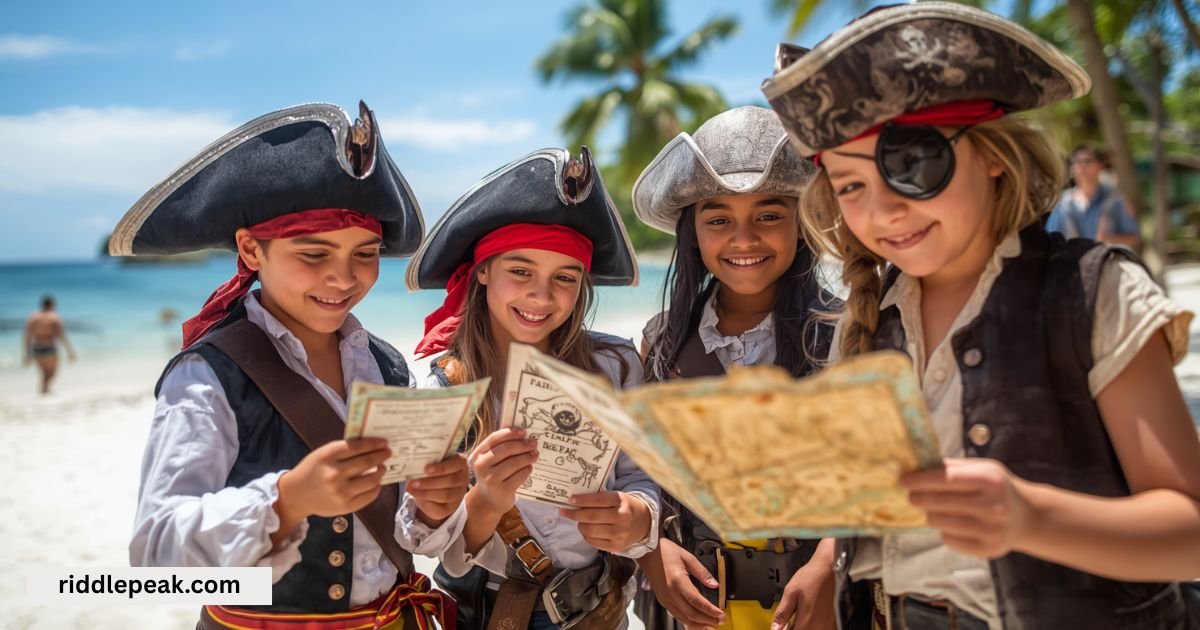
Easy Pirate Riddles for Kids (Ages 4–7)
These beginner pirate riddles use direct, vivid descriptions of well-known pirate objects. The clues are clear enough for preschoolers and kindergarteners while still being satisfying to guess. After testing these at pirate birthday parties with groups of 4- and 5-year-olds, these riddles generated the loudest “ARRR!” of approval when the answers were revealed.
Medium Pirate Riddles for Kids (Ages 7–11)
These riddles require more lateral thinking they use indirect metaphors, nautical vocabulary, and double meanings that reward careful listening. Perfect for classroom activities, family game nights, and the “harder clue” phase of a treasure hunt.

Riddles 31–50 (Medium level continued)
Hard Pirate Riddles for Older Kids and Adults
These riddles use historical facts about real pirates, advanced wordplay, logic puzzles, and multi-step reasoning. They’re perfect for ages 10+, classroom history units, and adults who enjoy a proper brain teaser with their swashbuckling fun.
Riddles 51–65 (Hard level continued)
Funny Pirate Riddles for Kids (Pirate Puns and Jokes)
These pirate riddle-jokes blur the line between brain teaser and comedy they use pirate vocabulary for puns, misdirection, and wordplay that makes children laugh out loud. Perfect for Talk Like a Pirate Day (September 19), birthday party icebreakers, and classroom mood-lifters.
Difficulty ratings are subjective and based on average audience feedback.
Explore our Camping Riddles for Kids for more entertaining brain teasers that are perfect for family camping nights, helping kids enjoy nature while developing critical thinking and observation skills.
Pirate Treasure Hunt Riddles Clues for the Perfect Scavenger Hunt (Riddles 81–110)
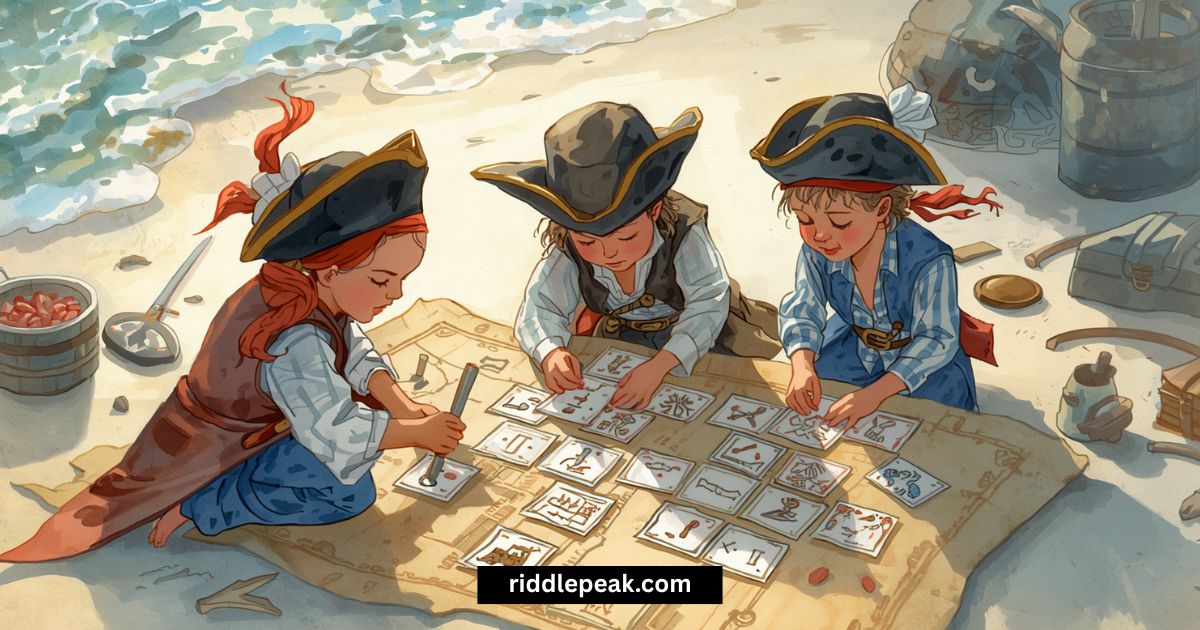
These riddles are specifically designed as treasure hunt clues each one points to a specific location, object, or action in a typical home, yard, or party venue. Use them in sequence to create a complete pirate adventure. Each riddle is written to work as a physical clue that leads children to the next location.
How to Use These as Treasure Hunt Clues
The most effective pirate treasure hunt structure has 8–12 clue stations. At each station, a physical clue card (printed or handwritten in pirate-speak) leads the group to the next location. Here’s the recommended sequence:
Station 1 (Starting point) → Riddle leads to Station 2 → … → Final Station = Treasure Chest
Tips from running 20+ pirate treasure hunts with children ages 5–12:
- Hide the clue slightly, not deeply frustration kills the magic.
- Make each station’s answer a location in the space (refrigerator, bookshelf, garden, etc.).
- Add a physical task at 3–4 stations (do 5 jumping jacks, tie a bandana, say “Arrr” 10 times).
- The treasure chest should contain small items for everyone not just the “winner.”
- Always have an adult who knows the full sequence in case a clue goes missing.
Riddles 91–110 (Additional treasure hunt clue riddles for extended hunts)
Pirate Riddles About Ships and Navigation (Riddles 101–120)
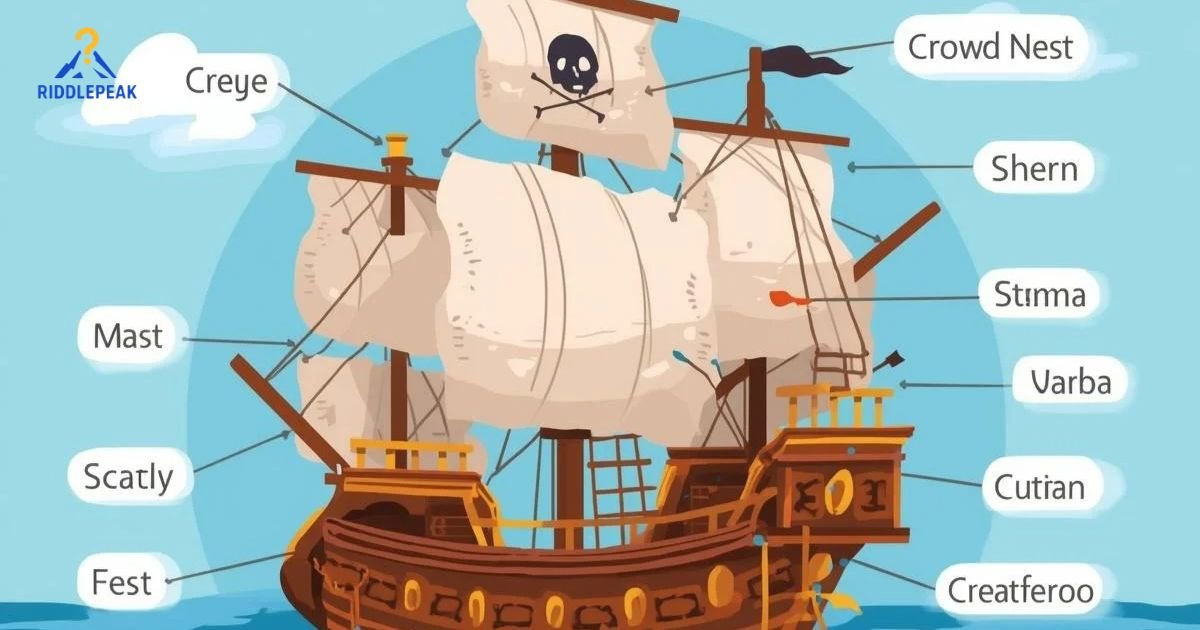
Nautical vocabulary is one of the richest and most underused teaching resources in children’s education. These riddles make maritime terms bow, stern, port, starboard, knot, fathom, league accessible and memorable through the adventure frame of pirate life.
The ocean is home to some of the most extraordinary creatures on Earth and pirates encountered them daily. These riddles use ocean life as riddle subjects while teaching genuine marine biology through the adventure frame.
Pirate Riddles Based on Real History (Riddles 121–140)
These riddles embed genuine historical facts real people, real ships, real events making each riddle simultaneously a brain teaser and a history lesson. After using these in classroom history units on exploration and maritime history, teachers reported that students who’d encountered the facts in riddle form retained them significantly better during follow-up assessments.
Extra Pirate Riddles Mixed Difficulty (Riddles 131–150)
These final 20 riddles are a mixed bag some easy, some tricky, all entertaining. Perfect for filling in the gaps in a treasure hunt, adding to a party game, or challenging any pirate who thinks they’ve seen it all.
How Do You Use Pirate Riddles in a Treasure Hunt?
After running dozens of pirate treasure hunts for birthday parties, school events, and family game days, here’s the complete step-by-step framework for turning these riddles into an unforgettable adventure.
Step 1: Plan your route. Walk through your venue (home, yard, park) and identify 8–12 possible “stations” specific locations where a clue can be hidden. Write down the stations in sequence. Each station is a location; each riddle points from one location to the next.
Step 2: Write your clues. Select riddles from the Treasure Hunt Clue section above, or adapt any riddle to point to your specific locations. Keep language simple for ages 4–6; add more complexity and vocabulary for ages 7–12.
Step 3: Create the clue cards. Print or handwrite each clue on a “treasure map style” card aged with tea, singed at the edges, or decorated with pirate symbols. The physical artifact of the clue makes the experience more immersive.
Step 4: Hide the clues. Place each clue at its station location before the game starts. Clue 1 is given to the children; Clue 2 is found when they solve Clue 1; and so on until they reach the treasure.
Step 5: Prepare the treasure chest. The final discovery should be proportional to the build-up. A wooden or plastic treasure chest filled with gold foil chocolates, plastic gold coins, small toys, and eye patches creates the perfect pay-off.
Step 6: Add physical challenges. At 2–3 stations, add a physical task before the next clue is revealed “do 10 jumping jacks like a sailor climbing the rigging” or “say the Pirate Oath before reading the next clue.” This builds energy and makes the hunt more memorable.
What Pirate Riddles Work Best for a Birthday Party?
The best birthday party pirate riddles have three qualities: they’re immediately understandable (no one gets confused and gives up), they have a satisfying “click” moment (the answer is surprising but obvious in retrospect), and they sound great in pirate voice.
For ages 4–6, stick to the Easy section simple one-or-two-clue riddles about eye patches, gold coins, parrots, and treasure chests. Use physical props: show an eye patch, then read the riddle. The prop gives young children a concrete reference.
For ages 7–10, mix Medium riddles with the Funny Puns section. The puns generate the most laughter at this age, while the medium riddles give children who love a challenge something to chew on.
For ages 10+, add 3–5 Hard riddles from the History section as bonus challenges a “Pirate Expert” title (or extra chocolate coins) goes to anyone who answers a history riddle correctly. This age group particularly enjoys the fact that pirates were real historical figures, not just fiction.
For adult co-hosts, the History riddles Blackbeard, the Jolly Roger’s origins, Queen Anne’s Revenge, Ching Shih make excellent conversation starters and demonstrate that pirate history is genuinely fascinating beyond the movies.
Conclusion
From the simplest “What am I?” riddles that make a 4-year-old shout “PARROT!” at the top of their lungs, to the hard historical brain teasers that stump even adults who know their Golden Age of Piracy, pirate riddles for kids are one of the most versatile, engaging, and genuinely educational party and classroom tools available. They teach history, vocabulary, math, critical thinking, and teamwork all while wearing an eye patch and shouting “Arrr!”
Bookmark this page for your next birthday party, Talk Like a Pirate Day (September 19), or classroom adventure. Share it with a parent who’s planning a treasure hunt or a teacher who wants December to end with something more memorable than a worksheet. And if one of these riddles becomes a family favorite, pass it on. That’s exactly how the best riddles survive for generations.
FAQs
What Are Some Good Pirate Riddles For Kids With Answers?
Great pirate riddles for kids include: “I cover one eye and I’m black as night pirates wear me to look just right. What am I?” (Eye Patch) and “I sit on a pirate’s shoulder, I squawk and talk I repeat what you say. What am I?” (Parrot). The best easy pirate riddles use the most iconic pirate imagery eye patches, treasure chests, parrots, and the Jolly Roger with vivid, direct clues that children ages 4–8 can quickly solve and celebrate.
How Do You Use Pirate Riddles In A Treasure Hunt?
For a pirate treasure hunt, use riddles as sequential clues: each riddle’s answer is a location where the next clue is hidden. Start with the easiest riddles and increase difficulty as the hunt progresses. Use 8–12 stations, hide clue cards at each location, and add physical challenges at 2–3 stations. End with a visible treasure chest (not buried deep) filled with gold foil chocolates, plastic coins, and small toys. Keep an adult who knows the full sequence on hand in case a clue goes missing.
What Are Funny Pirate Riddles That Kids Will Love?
The funniest pirate riddles for kids use pirate vocabulary for wordplay: “What’s a pirate’s favorite letter? You’d think it would be ‘R,’ but his first love would be ‘C’!” (the sea + the Arrr sound) and “Why can’t pirates play cards? Because they’re always sitting on the deck!” (ship deck + card deck). Children ages 6–12 consistently find puns that use “booty,” “Arrr,” and Captain Hook references the most reliably funny.
What Are Hard Pirate Riddles To Challenge Older Kids?
The hardest pirate riddles embed real history: “I had a beard so black that sailors named me after it I blockaded an entire American city in 1718. Who am I?” (Blackbeard) and “I commanded over 1,800 ships and 80,000 sailors I’m the most powerful pirate in all of history. Who am I?” (Ching Shih). For mathematical challenge: the “17 gold coins divided by borrowed coin” paradox and exponential treasure doubling riddles challenge ages 10+ while teaching real math concepts.
What Pirate Riddles Work Best For A Birthday Party?
For ages 4–6: single-clue easy riddles about eye patches, parrots, and treasure chests use physical props for support. For ages 7–10: medium riddles combined with pirate puns for maximum laughter. For ages 10+: add 3–5 history riddles (Blackbeard, Jolly Roger origins, real pirate ships) as “Pirate Expert” bonus challenges with extra prizes. The treasure hunt clue riddles work for all ages adjust the physical hiding spots and clue difficulty to match your group.